


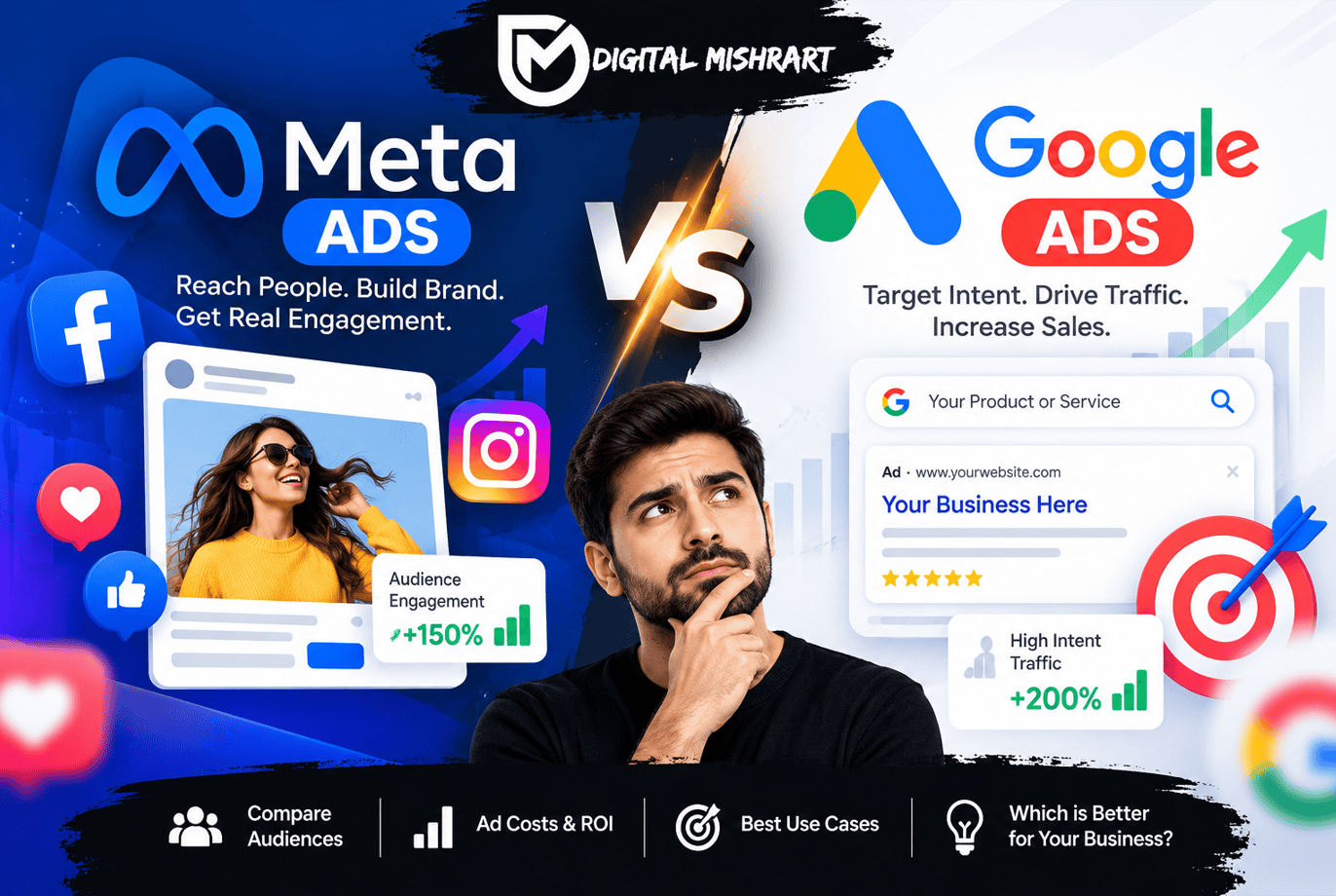
Choosing between Meta Ads vs Google Ads in 2026 is no longer a simple question of which advertising platform is better. For Indian businesses, the more important question is: where is your target customer in the buying journey, and which platform can reach them most effectively?
Google Ads and Meta Ads serve different purposes.
Google Ads can help businesses capture existing demand when people are actively searching for a product, service, brand, or solution. Meta Ads, which includes advertising across Facebook and Instagram, can help businesses create demand by introducing products and services to people based on their interests, behaviour, demographics, and interactions.
The Indian digital advertising market has also become much larger and more competitive. According to the 2026 dentsu-e4m Digital Advertising Report, digital advertising spending in India was projected to reach approximately ₹84,977 crore in 2026, with social media accounting for around 29% and paid search around 23% of digital advertising expenditure.
At the same time, both platforms are becoming increasingly AI-driven. Google is expanding AI-powered Search advertising, AI Max campaigns and ads within AI Overviews, while Meta is using AI extensively for campaign optimisation, ad ranking, creative generation and business messaging.
So, Meta Ads vs Google Ads in 2026 is not really about choosing one platform blindly. It is about understanding intent, audience behaviour, business model, conversion economics and the role each platform can play in your marketing funnel.
Meta Ads are paid advertisements that businesses can run across platforms such as Facebook and Instagram.
Unlike traditional search advertising, users generally do not open Facebook or Instagram because they want to search for a particular business or service. They are there to consume content, interact with creators, communicate with friends, discover products and explore interests.
This makes Meta particularly useful for demand generation and product discovery.
For example, imagine an Indian skincare brand launching a new vitamin C serum.
A potential customer may not search Google for that exact product because they do not know it exists. A well-designed Instagram Reel or Facebook ad can introduce the product, demonstrate the problem it solves and encourage the person to visit the website.
Meta’s advertising ecosystem is increasingly focused on AI-powered campaign optimisation. Meta says its advertising systems are using larger AI models to improve ad ranking and determine which advertisements are more likely to resonate with individual users.
Meta is also expanding business messaging and AI-based customer interactions. In 2026, Meta introduced Business Agent capabilities designed to answer customer questions, recommend products, qualify leads, book appointments and assist businesses with sales conversations.
That makes Meta particularly interesting for businesses that depend on visual discovery, lead generation, messaging and social commerce.
Google Ads is Google’s paid advertising platform that allows businesses to promote products and services across Google’s advertising ecosystem.
The most familiar format is Google Search Ads.
For example, if someone searches:
“best Performance marketing service in Delhi”
or
“SEO services in Delhi”
or
“Meta Ads service in Delhi”
that person is already expressing a specific level of intent.
A business can potentially appear in front of that user through Google Ads when the search is relevant to its offering and campaign targeting.
Google’s advertising ecosystem in 2026 has expanded beyond conventional keyword-based Search Ads. Google is introducing AI-powered advertising experiences including AI Max for Search and advertising opportunities around AI Overviews. Google also says ads can appear above, below or within eligible AI Overviews, including in India.
Google’s 2026 India updates also highlight the growing role of AI-powered Search, YouTube and other Google surfaces in consumer discovery. Google reported that Google and YouTube are present in 93% of consumer journeys for discovering a new brand, product or retailer in India.
This means Google Ads in 2026 is becoming much broader than simply bidding on individual keywords.
The simplest way to understand Meta Ads vs Google Ads is this:
Google Ads generally captures existing demand. Meta Ads generally helps create and stimulate demand.
Suppose someone searches:
“interior designer in Patna”
They already know they need an interior designer.
Google Ads can put a relevant interior design business in front of that person at the moment of search.
Now consider someone scrolling Instagram and watching home renovation videos.
They may not currently be searching for an interior designer.
But an attractive Meta Ad showing a modern modular kitchen, complete home transformation or before-and-after project could create interest.
That person may then visit the website, send a WhatsApp message or submit a lead form.
This difference is critical when deciding where your advertising budget should go.
| Factor | Meta Ads | Google Ads |
|---|---|---|
| Primary strength | Demand generation | Demand capture |
| Major platforms | Facebook, Instagram | Google Search, YouTube, Maps and other Google surfaces |
| User intent | Usually passive/discovery | Usually active/search intent |
| Creative importance | Extremely high | High, especially with AI-driven campaigns |
| Visual products | Very suitable | Suitable through Shopping/YouTube |
| Local services | Strong for lead generation | Strong for high-intent searches |
| Retargeting | Strong | Strong |
| Impulse purchases | Often effective | Can be effective |
| High-intent services | Can work | Often highly relevant |
| Brand awareness | Strong | Strong through YouTube and other surfaces |
| WhatsApp lead generation | Strong | Possible through relevant campaign setups and integrations |
| Testing creative concepts | Very useful | Useful, but different mechanics |
| Purchase journey | Discovery to consideration | Search/discovery to conversion |
The table should not be interpreted as a universal winner. Your business economics determine which platform makes more sense.
Meta Ads can be particularly useful when your business depends on visual content, discovery, audience targeting, social proof or direct conversations.
Indian D2C brands can use Meta to showcase products through:
Meta is especially useful when the product can be understood visually.
For example:
Meta’s 2026 India shopping research also highlights the growing role of short-form video in product discovery.
Meta can be useful for businesses that want leads through:
Examples include:
However, cheap leads do not automatically mean good leads.
A campaign generating leads at ₹100 each can be worse than another campaign generating leads at ₹300 each if the cheaper leads rarely convert.
The real metric should be cost per qualified lead and cost per customer, not just CPL.
Google Ads becomes particularly valuable when potential customers are already searching for the solution you provide.
For example:
These searches contain varying levels of commercial intent.
A person searching “what is SEO” is different from someone searching “SEO agency in Delhi pricing”.
The second search is much closer to a purchasing decision.
Google’s advertising system is also evolving around AI. Google says AI Max for Search is designed to help advertisers reach additional relevant searches beyond traditional keyword coverage, while its AI-powered advertising ecosystem is increasingly using broader contextual signals.
For lead-generation businesses, there is no universal answer.
Consider a dermatology clinic.
A clinic could show:
“Struggling with acne scars?”
The advertisement could show educational content, treatment information and a call to action such as:
Book a Consultation
The user may not have been searching for the clinic.
Meta created the initial awareness.
Another person searches:
“acne scar treatment in Kolkata”
This person already has a problem and is actively looking for a solution.
A Google Search Ad can capture that existing intent.
Therefore, a practical funnel could look like:
Meta Ads → Awareness → Consideration → Remarketing → Conversion
while another path could be:
Google Search → High Intent → Landing Page → Lead → Conversion
For some businesses, running both can create a stronger acquisition system than forcing the entire budget into one channel.
E-commerce businesses should think carefully about the customer’s buying journey.
Meta can be powerful for discovery.
Google can be powerful when users are already looking for products.
For example, a customer may discover a skincare product through an Instagram Reel.
Later, they may search the brand name or product on Google.
If the business is running both Meta and Google campaigns, the same customer can interact with both platforms during the purchase journey.
Google’s 2026 advertising updates are also expanding opportunities around Shopping, AI-powered Search and YouTube. Google says AI Max for Shopping uses Merchant Center feed information to understand products and improve campaign performance across the evolving Search environment.
This is one reason e-commerce businesses should avoid evaluating Meta and Google completely in isolation.
There is no honest universal answer.
Anyone saying “Meta Ads are always cheaper” or “Google Ads always gives better ROI” is oversimplifying the problem.
Advertising cost depends on:
Suppose:
Meta Ads
CPL = ₹200
Qualified leads = 20%
Customer acquisition cost = ₹1,000
Now consider:
Google Ads
CPL = ₹500
Qualified leads = 60%
Customer acquisition cost = approximately ₹833
Google generated a higher CPL but potentially a lower customer acquisition cost.
Therefore, CPC and CPL alone are not enough to judge advertising performance.
Businesses should track:
CAC → Conversion Rate → Revenue → ROAS → Profit
For small businesses, the right starting platform depends heavily on how customers discover the business.
For example, a local plumber may benefit from search intent because customers often need the service when a problem already exists.
A fashion brand, on the other hand, may have more opportunities to influence discovery through visual content.
For many businesses, yes, but not automatically.
Running both platforms simply because “everyone does it” is a poor strategy.
You need enough budget, tracking infrastructure and conversion volume to make the campaigns meaningful.
A more logical approach is:
Find out whether people are already searching for your product or service.
Determine whether your audience can be reached through visual content, interests, creators and social platforms.
Know:
Do not split a ₹500/day budget into five campaigns simply to “be everywhere.”
You may end up with insufficient data across every campaign.
Once you understand your economics, use the second channel to expand demand capture or demand generation.
The biggest change in 2026 is that both platforms are becoming increasingly dependent on AI.
Google is moving toward AI-powered Search experiences where advertisements can be matched not only to traditional keyword targeting but also to broader user intent and AI-generated search contexts. Google currently supports ads within AI Overviews in India for eligible queries and formats.
Meta is similarly investing heavily in AI-powered ad ranking, creative generation and campaign optimisation. Meta reported that its updated ad-ranking models produced measurable improvements in clicks, conversions and ads quality during Q4 2025.
This changes what advertisers need to focus on.
Instead of obsessing over individual campaign settings, businesses increasingly need to provide platforms with:
In other words, better inputs are becoming increasingly important as advertising platforms automate more of the optimisation process.
A practical approach could look like this:
Use Google Ads to capture high-intent searches.
Use Meta Ads to create awareness, generate leads and retarget website visitors.
Use Meta for product discovery, creative testing and social commerce.
Use Google Shopping/Search/YouTube to capture existing product demand and additional discovery opportunities.
Use Google to capture searches from businesses actively looking for solutions.
Use Meta selectively for retargeting, awareness and specific audience campaigns.
Use Google to capture high-intent treatment searches.
Use Meta for educational content, awareness, lead generation and remarketing, while ensuring advertising complies with applicable platform policies and healthcare advertising requirements.
There is no fixed percentage that works for every Indian business.
Instead of asking:
“Should I spend ₹10,000 on Meta or Google?”
ask:
“Where can I acquire a profitable customer at an acceptable CAC?”
For example, a business could initially test:
₹20,000 monthly budget
with a controlled split such as:
Or the opposite, depending on the business model.
But this should be treated as a test, not a universal formula.
After enough data is collected, budget should move toward the campaigns and audiences producing profitable incremental customers, not simply the cheapest clicks.
There is no universal winner in the Meta Ads vs Google Ads in 2026 debate.
The two platforms solve different marketing problems.
Meta Ads are generally well suited to discovery, visual storytelling, audience-based targeting, social commerce, remarketing and lead generation.
Google Ads are particularly valuable for capturing existing search intent, especially when customers know what they need and are actively looking for a product or service.
For many Indian businesses, the strongest long-term strategy may involve both platforms, but the role of each should be clearly defined.
Think of it this way:
Google Ads captures demand.
Meta Ads creates and stimulates demand.
Your job as a marketer is not to blindly choose one platform. Your job is to understand where demand exists, where demand can be created, what your customer acquisition economics look like and which channel can profitably move customers toward conversion.
In 2026, this becomes even more important because both Google and Meta are increasingly using AI to automate targeting, creative optimisation, ranking and campaign decisions.
The businesses that adapt will not necessarily be the ones spending the most money.
They will be the ones that understand their customers, measure the full conversion journey and give advertising platforms better data, better creative and better offers.
Neither platform is universally better. Meta Ads and Google Ads are designed around different user behaviours. Meta is often stronger for discovery and demand generation, while Google can be particularly valuable for capturing existing search intent.
Neither is consistently cheaper. Advertising costs vary by industry, audience, location, competition and conversion rate. The better comparison is customer acquisition cost and profit rather than CPC alone.
It depends on how customers discover the business. Search-driven services may benefit from Google Ads, while visually driven products and discovery-led businesses may find Meta useful. Some businesses can benefit from both.
Yes. Google continues to expand its advertising ecosystem through Search, YouTube, Shopping, AI-powered Search and other surfaces. Its 2026 updates include AI Max and advertising opportunities connected to AI Overviews.
Meta continues to invest heavily in AI-powered advertising, creative optimisation, ad ranking and business messaging. Its 2026 product developments show that Meta remains focused on improving automated advertising performance and business-to-customer interactions.
Yes. In fact, combining demand generation from Meta with demand capture through Google can create a broader acquisition system. However, the decision should be based on budget, tracking, conversion volume and profitability.
Do not compare platforms only using impressions, clicks or CPC. Track qualified leads, conversion rate, customer acquisition cost, revenue, ROAS, profit and customer lifetime value.
The Meta Ads vs Google Ads in 2026 question has no one-size-fits-all answer.
Indian businesses should choose their advertising platform based on customer intent, business model, sales cycle, product type, budget and profitability.
If customers are already searching for your solution, Google Ads can help you capture that intent.
If customers need to discover your product or service first, Meta Ads can help create that demand.
And if your business has enough budget and conversion volume, combining both can allow you to build a complete customer acquisition journey from discovery to conversion.
The most important thing is not choosing the “best” advertising platform.
It is choosing the platform that matches how your customers actually buy.
If you want to hire a Meta Ads Expert Freelancer for your business then click on it.
 Call Now
 WhatsApp